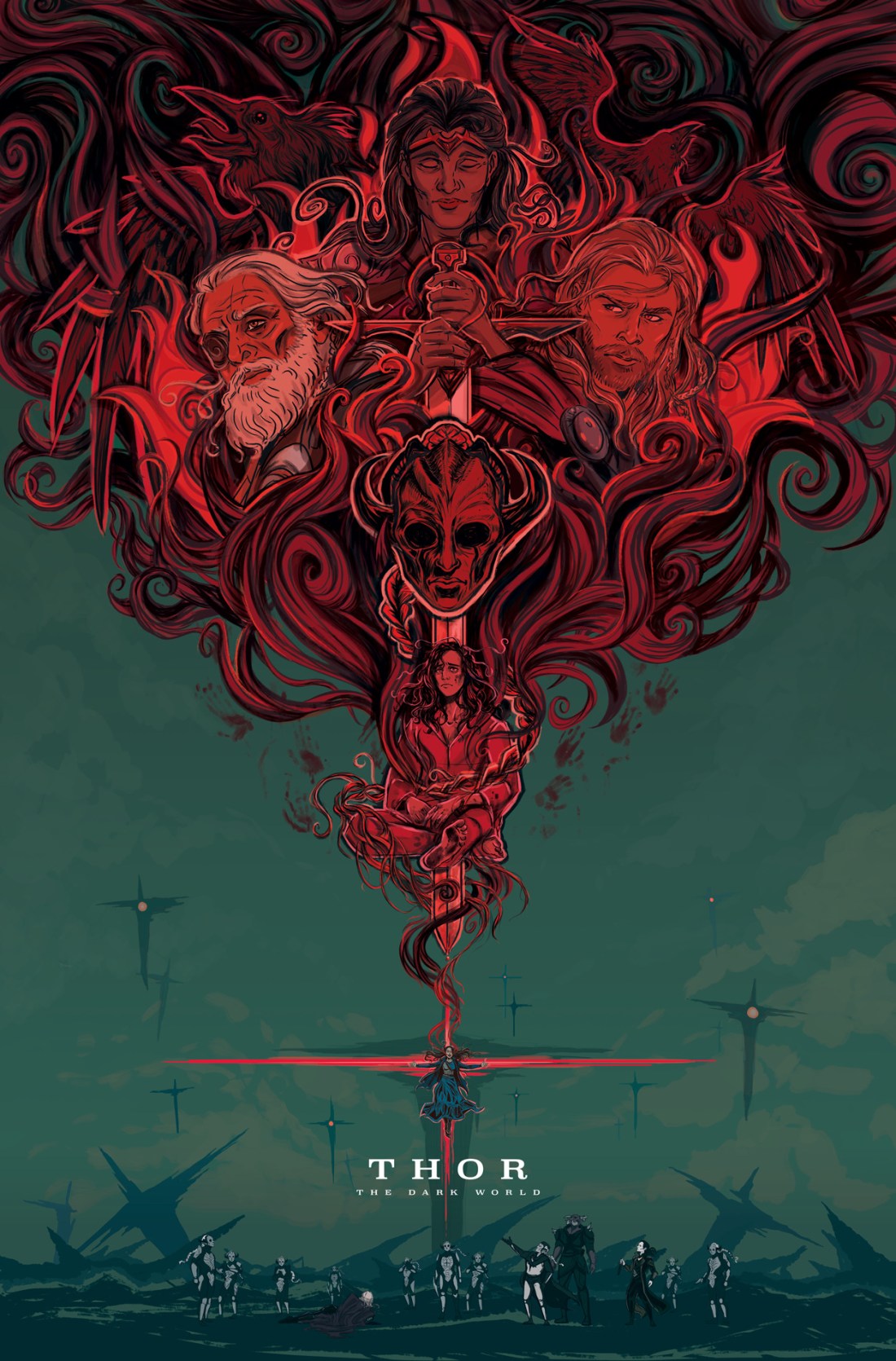
I’d like to apologize for all the THOR art. I swear I am drawing other things, and lots of them, but I’m having to keep them to myself right now. They’re mostly to do with some comic zines I’m fuggering out. My feelings about TDW are…complicated. There are few films that fill me with as much frustration. But there is much to love as well, and I started this with the intention of doing something nice for a new friend of mine who truly loves it, and before I knew it, it got way more detailed than I anticipated. Helped me work through those complicated feelings, heh heh. I did do some thumbs for the first and third in the trilogy as well. I have another couple friends who really like those movies, and birthdays coming up…why not.
For this one, I wanted to focus on the theme of grief. I am loathe to explain my pieces but forgive me again, it’s been a while since an art school critique and I thought I’d point out at least a couple of my choices.
The large cloud of Aether creates a ‘divine’ sort of overhanging presence over the small figures below (one of those floating heads should shout ‘Get on with it!’ I suppose.) The name ‚Aether’ reminds me of the term from Greek myth, which is both a primordial deity (son of Chaos and Darkness) and the name of the air only the gods could breathe. Thus, this blood-like air chokes and smothers even as it gives life by making up the very forms themselves. A lot of Asgard’s old violence is again revealed in this film, even if it isn’t as condemned as it should be until Ragnarok, and much of their old violence is returned to them, notably with the violent death of Frigga.
I’m sure my repeated use of the cross is apparent – Norse Myths these may be, but thanks to Sturluson and the Americanization of the film and comics, they are very Christianized. The cross also has four points, one for each member of the Royal Family. Four is also a number associated with death in Japan, and I admit I often think of that and use it even subconsciously when dealing with the subject. Frigga, though her screentime is limited, is the dominant figure of the film in terms of impact, much like how Odin is in the first, so she is the highest figure in the poster and the character who connects and touches all the others. Her death functions not only as the catalyst for the plot but shakes up the family dynamics. Thor and Odin, initially aligned, are estranged when Odin’s grief makes him aggressive and reckless. Thus the main cross element, Frigga’s funeral sword, comes between them, while simultaneously being the line that connects them to the estranged Loki. Loki is separated from the rest of his family by the looming Dark Elf mask. The mask works to symbolize a few things – Otherness and Alienation, of which Loki is still subject to, thanks to his reviled heritage and own sense of unbelonging. The film itself draws parallels between Loki and the Dark Elves, in particular Kurse, a funhouse reflection of him in narrative and design. Kurse chooses to take on a monstrous appearance and is embraced as a self-sacrificing hero for it. Meanwhile, Loki has his true form (thought monstrous) hidden away and is shunned for his twisted attempts to be heroic. Loki himself connects the two of them by implying they will go to the same undesirable afterlife in the film, a rather sad note that highlights his sentiments of separation and self-disgust. Finally, being a mask, it, of course, infers concealment of identity and expression, a blank facade to hide behind, which is Loki’s whole schtick. Even if it is a monstrous, unfeeling mask, he still exists in all his muss beneath it. My favourite scene is the unravelling of Loki in his cell, where the illusions, for a moment, are dropped. Thus the braid of the mask coming undone, much like Loki himself. Frigga’s sword pierces him through, as her death affects him greatest in the family, thanks to their previously strong bond and her being the only one who still had faith in him. It is this faith that continues to connect him to the family members who turned their backs to him, even after her death.
The cross element descends into the little miniature scene below with the red glare behind Jane, who is also in the form of a cross; I intended no Jesus symbolism, but she is a vessel for ‚divinity’ in the form of the Aether, I suppose. This cross divides the little figures of Thor and Loki still – this is the scene where Loki pretends to be on Malekith’s side, after all (he is directly below Thor’s giant head, so thus really on his side) – but already Loki has a knife out, ready for some trademark backstabbing. Careful, Kurse, you’re nearest…
Hugin and Munin, Thought and Memory, make a brief appearance at the start of the film, excusing my inclusion of them here. As carrion birds, they already have a strong association with Death here in the West, but I think Thought and Memory as concepts are the more important to me, as it is in these only the departed continue to exist. Hence, they frame Frigga and also hang over the film.
My grandfather having recently passed, I suppose it’s little wonder I was drawn to do this poster first. That and I had the clearest ideas for it. There’s a few more choices in here, but I’ll keep a few secrets for myself and something for you to interpret.

 We Are What We Feel